Chapter 6: Information Privilege, Civic Engagement, Open Access
6.1 Understanding Information Privilege
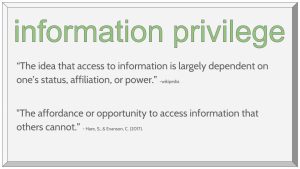
Simply put, information privilege is the idea that information access is based on one’s status, connection and power. This access to information can be hindered by many factors such as geography, technology access, identity, and economic status. The types of information that are often limited are research and academic articles. Most colleges and universities pay to provide access to this information.
Broken down to understand the concept of information privilege further, the Association of Colleges and Research Libraries created the Framework for Information Literacy for Higher Education, and within that document, privilege is noted as coming mostly from the Authority, Value, and Scholarship of the information. Authority is the concept that some voices are noticed, uplifted, and amplified over others for reasons like education, expertise, experience, and position. Value notes there is often a monetary value behind a piece of information. And Scholarship is the system that determines who gets to speak on a topic, be the “expert” of a subject, be published in a journal, and who is either heard or shutout because of the communication system in place. Realizing that because society deems a piece of information as an authority, that is valuable, or this researcher gets published globally, it all creates a state of privilege.
College and university libraries strive to provide robust and broad collections to support the variety of student needs and subjects studied. Those attending an institution of higher education typically have a high level of information privilege, or access to information not otherwise available to the outside public. Public libraries provide communities with access to information (and the Internet) but generally can’t afford the robust collections held at universities. This furthers an information divide.
Cost of Information
The cost for most professional journals and databases is frequently thousands of dollars per year. For example, Steely Library spends nearly two million dollars a year on information access for the NKU community. Consider some of the following resources and their costs at various universities.
- At the University of North Texas, the database called Access World News was $35,960 dollars in 2015 and a subscription to the journal, American Philosophical Quarterly (for example) was $333 for the year.
There are many consequences of lacking information access. It can impact one’s skills to evaluate, locate and use information, and discern

life and death when people are faced with medical choices. Limiting access to information can lead to a community riddled with misinformation and continue the growth of inequality and marginalization.
Generative AI and Information Privilege
The introduction of genAI into the current system of information and privilege will, at best, help democratize the space for all people worldwide or, at worst, exacerbate the current systems which will widen the information gaps for everyone. As discussed in her article, Generative AI
and the Reinforcement of Information Privilege, Mazel states that most genAI assistants are offered with free and paid versions–one layer of privilege. On top of that, any genAI assistant is reliant upon that user’s privilege to paywalled information; the mere subscription to the GenAI assistant does not come with access to this type of privileged information available to university students for example. Finally, users must also be trained or versed in how to use genAI tools. Being able to write questions or prompts that the tool can decipher from real language and return meaningful results is something that is currently being promised by the technology creators and questioned by critics and users.
Although there is an appropriate way to use genAI tools in academic research and college courses, many students looking for shortcuts should be mindful of some caveats. Mazel further explains that these tools have been known to create sources out of thin air, lacked transparency on where information was gathered, and provided incomplete summaries. The monetization of such technology will only create a slew of access levels and more information privilege. Students and teachers need to develop tools and skills to work with, around, and ahead of genAI. In the end, all information literate users need an awareness of the downfalls, over-hyped promises from for-profit companies, and delusions about the abilities of genAI.