Chapter 7: Ethical and Legal Dimensions of Information
7.5 Copyright
Copyright refers to laws to protect the works and the rights of authors. These laws determine how or if someone else’s protected work can be legally copied, shared, performed, reused, or modified. Copyright infringement means copying or distributing someone else’s copyrighted material without permission. As soon as you create something that is your own work, such as a short story you’ve written or a video, you hold that work’s copyright in the United States.
Copyright can also be sold or licensed to another person or company, who then has control over what happens to the copyrighted content. For example, authors are often required to sign over their copyright upon publication, effectively handing over the rights to the companies that publish their work. This model enables publishers to charge outrageously high prices for journals, books, and textbooks. This is also why you cannot stream the tv series you like on every platform, and why Nintendo doesn’t let you livestream their video games.
Public domain
Not all creative works are copyrighted. Works that are not protected by copyright are in the public domain. This means that you don’t have to ask for permission from a copyright holder to reuse the content. Materials in the public domain typically fall into one of two categories.
- Materials that are not copyrighted: Published US government documents are, by design, never copyrighted because they are meant to be open to all. For example, transcripts of congressional hearings are government documents, as are images from NASA, and the data from the US Census. Other materials that cannot be copyrighted include simple mathematical equations and food recipes.
- Materials whose copyright has expired: Books published 95 years ago or longer in the US are another example of public domain materials. Their copyright protection has simply expired. The original intent of copyright law was to protect an author’s rights of redistribution and sales, but authors of works published so long ago are probably not alive anymore. Thus the need to protect that author’s profits is also gone.
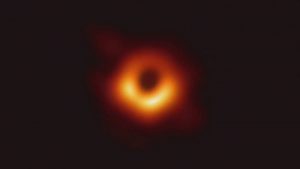
Does this mean that you can copy content from a US government website, such as this image from NASA, without asking for permission? Yes, you can!
Can you use it in an assignment without citing the source? No, that would be plagiarism. It’s important to always credit the source, regardless of whether or not it is in the public domain.
You can find a lot of public domain works on the internet using tools like Google Books and searching for works published 95 years ago or earlier. The Internet Archive is another good source of public domain books, films, and other materials. If you don’t know whether something is copyrighted, it is best to assume everything you find online is copyrighted unless you find an explicit statement indicating otherwise.
Licensing copyrighted works
Most works are under full, “all rights reserved” copyright. This means that they cannot be reused in any way without permission from the copyright holder. One way you can get permission to use someone else’s work is through a license, a statement or contract that allows you to reuse a copyrighted work in specific circumstances. For example, the copyright holder for a popular book might sign a license to provide a movie studio with the rights to use their characters in a film.
Creative Commons licenses
Creative Commons licenses are a type of copyright license that lets the creator specify the ways others can reuse their work. They were created to encourage sharing by making it easy to identify which works can be shared. These licenses help users understand what they can and can’t do when reusing someone else’s work.
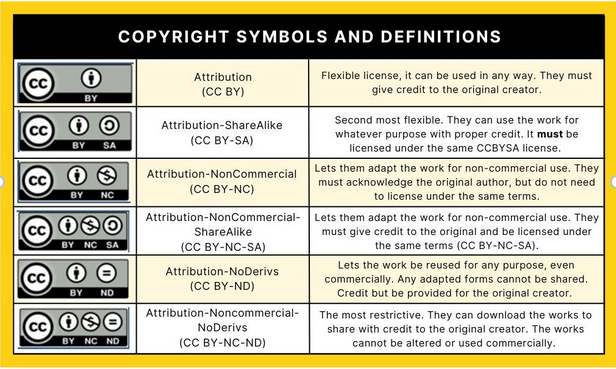
There are six Creative Commons licenses, each with different rules, and attaching a license to your work lets others know how they may use your material. For example, a creator can use one type of Creative Commons license to specify that others can reuse their work but not make money off of it. Alternatively, they might use a license that says users cannot modify their work in any way. View the image above for a description of each license or read about them at the Creative Commons website.
Popular sites like YouTube, Wikipedia, Flickr, and many others have used Creative Commons licenses for years. You can even search for images available under a Creative Commons license using Google Image Search.
How does copyright affect you?
Copyright affects you both as a user and creator of information.
As an information user, you need to know:
- whether a work you want to share, copy, or modify is still under copyright or in the public domain;
- what license is applied to the work, such as a Creative Commons license that specifies conditions for reuse, or a commercial license that requires a fee; and
- who holds the copyright, so you know who to ask for permission to reuse their work.
As an information creator, you need to know:
- that your creative works are protected by copyright law;
- that you have the right to decide how your works can be used or shared, such as by applying a Creative Commons license;
- that you can keep or sign away your copyright; for example, when you post to a social media platform, you might be signing away your rights for that content as part of the company’s terms of use.
If you want to learn more about copyright law, copyright.gov from the U.S. Copyright Office is a good place to start.